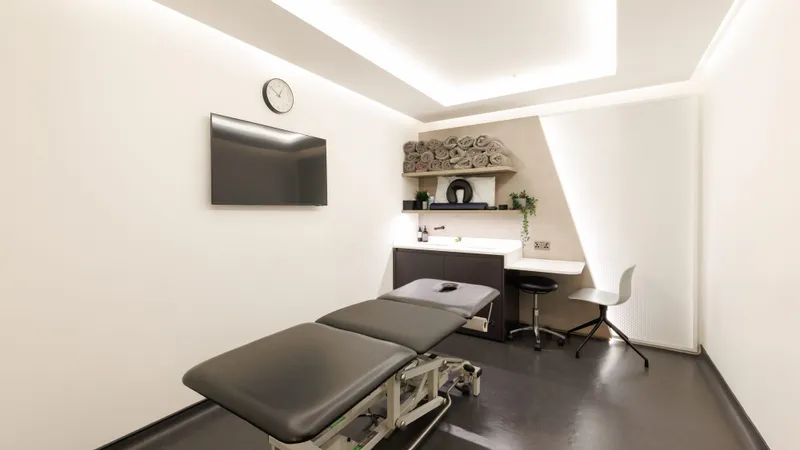
Assess
A detailed history and a thorough examination of movement, strength and the affected area. You leave knowing what is wrong, why it happened and exactly what we are going to do about it.
Hip and groin pain is one of the harder regions to diagnose, because the joint, the surrounding tendons, the lower back and the abdominal wall can all produce pain in a similar place. Getting the source right is most of the work.

Overview
The hip and groin refer pain in confusing ways. True hip joint pain is usually felt deep in the groin rather than on the outside of the hip, while pain on the outer hip is more often gluteal tendinopathy. Meanwhile the lumbar spine can refer pain into the buttock and thigh convincingly enough to be mistaken for a hip problem entirely.
The common presentations we treat are gluteal tendinopathy (lateral hip pain, often painful to lie on), hip osteoarthritis (deep groin pain and stiffness, worse with activity and in the morning), adductor-related groin pain in kicking and change-of-direction sports, and femoroacetabular impingement in younger, active people.
Assessment separates these and identifies referred pain from the lumbar spine. Treatment then combines manual therapy with progressive loading, which is the evidence-based approach across almost all of these presentations.
Excellent
From 4 five-star Google reviews
Source: Google
I saw Amanda for a problem I've been having with a painful shoulder. She explained to me what the problem was, did a thorough treatment session and gave me some exercises to do to improve it. Very professional and friendly, I highly recommend her.
I first visited Amanda following a maisonneuve fracture. That day I walked 107 steps in a camboot with two crutches. I have visited weekly. Yesterday I walked 13,315 steps (no crutches, no boot). The transformation is truly amazing.
I booked with Michelle for my first appointment. When I stood up I said to her it feels like heaven as my continuous back pain had totally gone. I was totally pain free for 7 hours so bless you Michelle.
Excellent treatment of my lower back and related sciatica injuries from CrossFit. Definitely my go-to therapist when in dire need of pain relief.
The hip joint, the gluteal tendons, the adductors and the lumbar spine all refer pain into a similar area. Testing each properly is what turns a vague hip problem into a treatable diagnosis.
Pain lying on the outer hip is characteristic of gluteal tendinopathy. Simple positioning changes usually help quickly, and progressive loading of the gluteal muscles is what resolves it properly.
Aggressive stretching frequently makes gluteal tendinopathy worse by compressing the tendon further. Knowing which of the two your problem needs is exactly why the diagnosis comes first.
Exercise is core treatment for hip osteoarthritis under NICE guidance, and many people manage well for years on a structured programme. Surgery becomes a considered decision rather than an inevitability.
Adductor-related groin pain in kicking and change-of-direction sport responds to graded strengthening. We build towards the specific demands of your sport so the return holds up under match conditions.
Why it happens
Gluteal tendinopathy from compressive loading through the outer hip
Osteoarthritis of the hip joint, increasingly common from middle age
Adductor-related groin pain from kicking, sprinting and change-of-direction sport
Femoroacetabular impingement, typically in younger and more active people
Referred pain from the lumbar spine mimicking a hip or buttock problem
A rapid increase in running or gym volume beyond current capacity

Your first visit is a full 60-minute assessment: a detailed history, then testing of how you move, how strong you are and what the painful area is actually doing. We explain the working diagnosis in plain English and agree a plan with you before any treatment starts.
You leave with a written summary and a home programme, emailed the same day and loaded into the Move Health app so the technique stays right between visits.
The starting point for better health. Our clinics work together to take you from injury, through recovery and performance, to the kind of health that holds up for decades. One team, one plan, one record of where you started.

You can refer yourself, with no GP letter needed, and book online in a couple of minutes at whichever clinic is easier to reach.
Most people arrive with something that hurts. What happens after that is the part most clinics leave to chance. We treat the problem, rebuild the capacity you lost, then keep you strong enough that it stays fixed.
A detailed history and a thorough examination of movement, strength and the affected area. You leave knowing what is wrong, why it happened and exactly what we are going to do about it.

Hands-on manual therapy chosen for your presentation, with Western medical acupuncture or soft-tissue work added where they help. Treatment is not the goal in itself: it opens the window to move and load properly.

Progressive, coached exercise rehabilitation restores the strength and load tolerance you lost, with full gym facilities at both clinics. This is the stage that decides whether the fix lasts.

Each follow-up measures you against your own baseline. We discharge you when you have the strength and the tools to manage alone, with clinical Pilates, sports massage and golf screening on hand to keep you there.

Treatment approach
Distinguishing hip joint pain, gluteal tendinopathy, adductor-related groin pain and referred lumbar pain is the single most important step, because each needs a different loading strategy.
See treatment detail →Progressive loading of the gluteal and adductor musculature is the evidence-based treatment for tendinopathy and for hip osteoarthritis alike.
See treatment detail →Soft-tissue work through the hip and thigh musculature can ease symptoms enough to make the loading programme more comfortable to progress.
See treatment detail →FAQ
Pain on lying on the outer hip is characteristic of gluteal tendinopathy, where the tendon is compressed against the bone. Sleeping with a pillow between the knees usually helps, and progressive loading of the gluteal muscles is the treatment that resolves it.
Both are possible and they can feel similar. True hip joint pain is usually felt deep in the groin, while lumbar spine problems more often refer into the buttock and back of the thigh. Assessment involves testing both regions to establish the source.
Not always. For gluteal tendinopathy, aggressive stretching often compresses the tendon further and makes symptoms worse. Progressive strengthening is generally the better route, which is why a diagnosis matters before starting anything.
Not necessarily, and not usually as a first step. Exercise is core treatment for hip osteoarthritis under NICE guidance and many people manage well for years with a structured programme. Surgery is considered when symptoms remain limiting despite proper conservative treatment.
Get Started
Origin Health • 280 Bishopsgate, Liverpool Street, London EC2M 4RB
BookAppointments typically available within 1–2 weeks