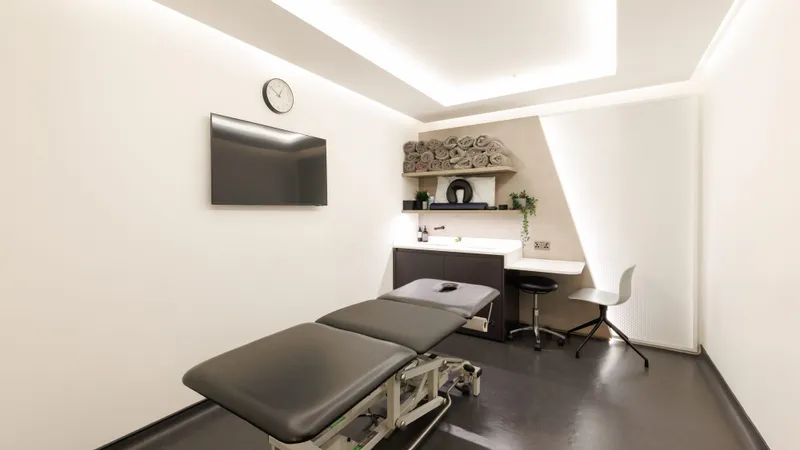
Assess
A detailed history and a thorough examination of movement, strength and the affected area. You leave knowing what is wrong, why it happened and exactly what we are going to do about it.
Tennis elbow, golfer’s elbow and keyboard-related wrist pain are the presentations we see most in the City. All three are load problems rather than damage, and all three respond to graded strengthening once the aggravating load is understood.

Overview
Elbow, wrist and hand pain in desk-based workers usually comes down to a mismatch between what the tissue can tolerate and what it is being asked to do, whether that is at a keyboard, in the gym or on a racket court.
Lateral elbow tendinopathy, commonly called tennis elbow, produces pain on the outside of the elbow, worse on gripping, lifting a kettle or shaking hands. Medial elbow tendinopathy, or golfer’s elbow, does the same on the inner side. Both are tendon load problems and both respond to progressive strengthening, though they are slow.
Wrist and hand pain in office workers is frequently related to sustained keyboard and mouse position combined with low forearm strength. Where symptoms include numbness or tingling, particularly at night, assessment considers nerve compression such as carpal tunnel syndrome and refers on where appropriate.
Treatment runs through physiotherapy, with graded loading via exercise rehabilitation as the core of it.
Excellent
From 4 five-star Google reviews
Source: Google
I saw Amanda for a problem I've been having with a painful shoulder. She explained to me what the problem was, did a thorough treatment session and gave me some exercises to do to improve it. Very professional and friendly, I highly recommend her.
I first visited Amanda following a maisonneuve fracture. That day I walked 107 steps in a camboot with two crutches. I have visited weekly. Yesterday I walked 13,315 steps (no crutches, no boot). The transformation is truly amazing.
I booked with Michelle for my first appointment. When I stood up I said to her it feels like heaven as my continuous back pain had totally gone. I was totally pain free for 7 hours so bless you Michelle.
Excellent treatment of my lower back and related sciatica injuries from CrossFit. Definitely my go-to therapist when in dire need of pain relief.
Pain on gripping a kettle or shaking hands is the classic tennis elbow presentation. Graded strengthening of the forearm builds the tolerance back, which is what makes everyday tasks comfortable again.
Most lateral elbow tendinopathy we see comes from keyboard work, gripping and lifting rather than racket sport. Knowing the actual driver is what lets you change it rather than avoiding a sport you never played.
Numbness or tingling, especially at night, points towards nerve compression rather than tendinopathy. Assessment separates them, and we refer on for nerve conduction studies or a surgical opinion where that is the right route.
Sustained non-neutral wrist positions at a poorly set-up desk are a frequent driver in City workers. Practical changes to your setup reduce the provocation while the strengthening does the longer-term work.
Why it happens
Repetitive gripping, lifting or keyboard and mouse work exceeding tissue tolerance
A rapid increase in racket sport, climbing or gym volume
Low forearm and grip strength relative to the demand being placed on it
Sustained non-neutral wrist positions at a poorly set-up workstation
Nerve compression such as carpal tunnel syndrome, particularly where symptoms wake you at night
Previous elbow or wrist injury

Your first visit is a full 60-minute assessment: a detailed history, then testing of how you move, how strong you are and what the painful area is actually doing. We explain the working diagnosis in plain English and agree a plan with you before any treatment starts.
You leave with a written summary and a home programme, emailed the same day and loaded into the Move Health app so the technique stays right between visits.
The starting point for better health. Our clinics work together to take you from injury, through recovery and performance, to the kind of health that holds up for decades. One team, one plan, one record of where you started.

You can refer yourself, with no GP letter needed, and book online in a couple of minutes at whichever clinic is easier to reach.
Most people arrive with something that hurts. What happens after that is the part most clinics leave to chance. We treat the problem, rebuild the capacity you lost, then keep you strong enough that it stays fixed.
A detailed history and a thorough examination of movement, strength and the affected area. You leave knowing what is wrong, why it happened and exactly what we are going to do about it.

Hands-on manual therapy chosen for your presentation, with Western medical acupuncture or soft-tissue work added where they help. Treatment is not the goal in itself: it opens the window to move and load properly.

Progressive, coached exercise rehabilitation restores the strength and load tolerance you lost, with full gym facilities at both clinics. This is the stage that decides whether the fix lasts.

Each follow-up measures you against your own baseline. We discharge you when you have the strength and the tools to manage alone, with clinical Pilates, sports massage and golf screening on hand to keep you there.

Treatment approach
Assessment separates tendinopathy, nerve compression and referred pain from the neck, which present similarly in the forearm and hand but need different management.
See treatment detail →Progressive loading of the forearm musculature is the evidence-based treatment for lateral and medial elbow tendinopathy, alongside managing the aggravating load.
See treatment detail →Soft-tissue work through the forearm can ease symptoms sufficiently to make the strengthening programme more comfortable in the early stages.
See treatment detail →FAQ
No, and most people we treat for it do not. Lateral elbow tendinopathy is far more commonly caused by repetitive gripping, lifting and keyboard work than by racket sport. The name is historical rather than descriptive of who actually gets it.
Typically three to six months with consistent loading, sometimes longer where the aggravating activity cannot be reduced much. It is slow, and progress is measured over months rather than weeks, but graded strengthening reliably outperforms rest.
A brace can help manage symptoms in the short term, particularly if your work is unavoidably provocative. It does not build tolerance though, so it works best as an adjunct alongside a loading programme rather than as the treatment itself.
Numbness or tingling, particularly waking you at night, may point to nerve compression such as carpal tunnel syndrome rather than a tendon problem. We assess for this and will refer you on for nerve conduction studies or a surgical opinion where appropriate.
Get Started
Origin Health • 280 Bishopsgate, Liverpool Street, London EC2M 4RB
BookAppointments typically available within 1–2 weeks